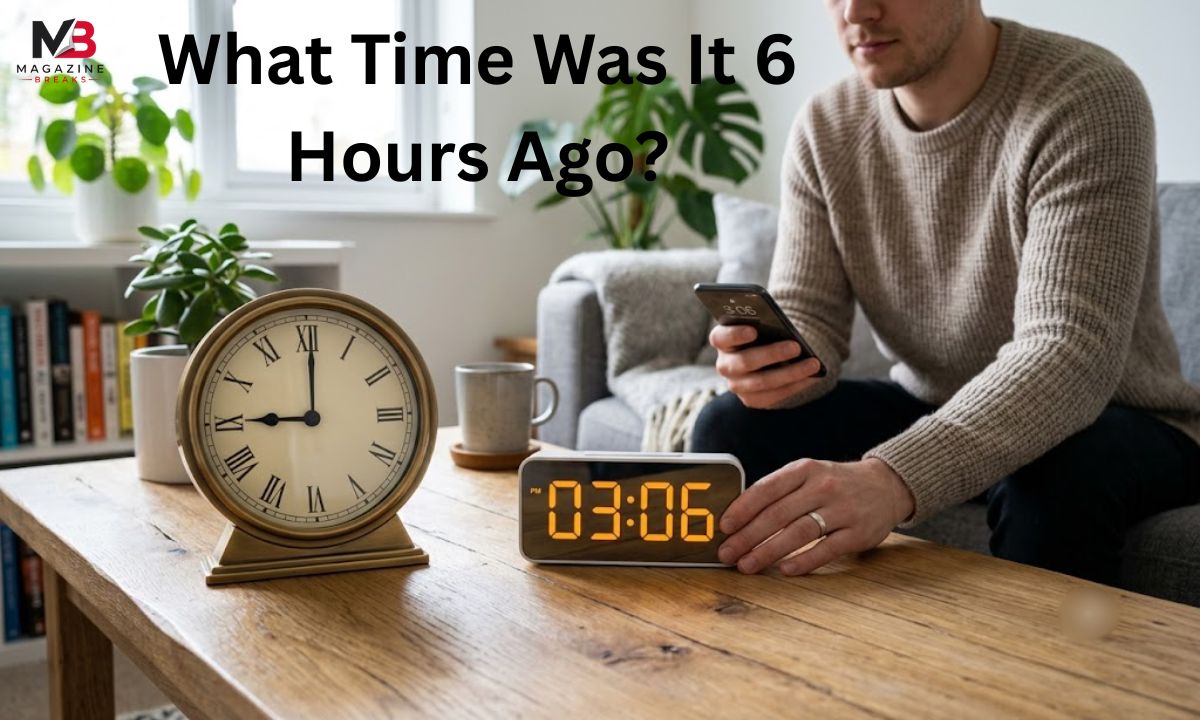
What Time Was It 6 Hours Ago?
Quick answer first. To find what time was it 6 hours ago, just take the current clock time and subtract 6 hours from current time. That’s it. No hard math, no confusion.
If it’s 2:00 PM right now, then 6 hours ago from now it was 8:00 AM. If it’s 3:00 AM right now, then it was 9:00 PM yesterday. Simple time subtraction, done in seconds.
This guide breaks the whole thing down so you never have to guess again. We will cover the time arithmetic, real examples, and even the tools that do this time calculation for you.
What Time Was It 6 Hours Ago? Understanding the Mind of the Clock
Your brain does this weird thing when someone asks what was 6 hours ago. It freezes for a second, like it forgot how numbers work. That’s normal, everyone does it.
The trick is thinking in a 12-hour clock or 24-hour clock frame and moving backward. Once you subtract, check if you crossed midnight. That single step trips up most people.
Here’s a fast time difference calculator style table so you can just glance and go.
| Current clock time | Exact time 6 hours ago |
| 12:00 AM | 6:00 PM (yesterday) |
| 3:00 AM | 9:00 PM (yesterday) |
| 6:00 AM | 12:00 AM (midnight calculation) |
| 9:00 AM | 3:00 AM |
| 12:00 PM | 6:00 AM |
| 3:00 PM | 9:00 AM |
| 6:00 PM | 12:00 PM (noon calculation) |
| 9:00 PM | 3:00 PM |
What Time Was It 6 Hours Ago? Step by Step Time Arithmetic in GMT+5 Reality

Let’s walk through real previous time calculation steps. First, look at your current timestamp. Say it’s 2:00 PM today.
Next, do the time subtraction. 2:00 PM minus 6 hours lands you at 8:00 AM the same day. Easy win, no drama.
Now the tricky part. If your current time is 3:00 AM, subtracting 6 hours pushes you into previous day calculation territory. That means 3:00 AM minus 6 hours equals 9:00 PM the day before, not the same day.
People living in GMT+5 time zones, like Pakistan, often deal with this while messaging friends in other local time zones. Knowing your own offset from UTC time makes cross country chats way less confusing.
Here’s the unit breakdown people search for a lot. Six hours equals 360 minutes, or 21,600 seconds, or 21,600,000 milliseconds. You will probably never need milliseconds, but now you know it exists.
What Time Was It 6 Hours Ago? Real Life Moments People Actually Relate To
Nobody asks this question just for fun. There’s always a real moment behind it, like checking when you sent a text or missed a call.
Think about a night shift worker checking their today’s time against yesterday’s time before clocking out. Or a student realizing their 3 AM study session actually happened while everyone else was already asleep.
Here’s the honest part. Most people ask this because they lost track during a long call, a late movie, or a scroll session that ate their whole evening.
That’s not a bad thing. It just means time measurement in your head and time measurement on the clock don’t always match, and that’s completely human.
Digital Tools and the Quiet Machines That Calculate Our Confusion

You don’t have to do this math by hand every single time. An online time calculator or hour calculator does the heavy lifting in one click.
Most time calculation tool options let you punch in your current local time and instantly get the past hour you need. No pen, no paper, no second guessing.
Tools like a time zone converter, world clock, or date calculator are useful if you talk to people across different local time zones. They also handle add and subtract time requests without you lifting a finger.
If you want speed, search for an instant time calculator or past time calculator. These give you the exact current time minus any hours you type in, right away.
AM PM Confusion and How to Avoid It
The AM and PM calculator mix up is real, and it trips up even sharp people. Going from PM to AM across midnight is where most mistakes happen.
Here’s the simple rule. If subtracting 6 hours takes you past 12:00 AM, you flip from today into yesterday, and PM becomes AM or the other way round.
Write it out if you need to. Current time, minus 6, check if you crossed midnight, done. That’s the whole clock conversion process.
Time Zones, GMT+5, and Why Location Matters

Your current time calculation always depends on where you are standing. GMT+5 time is common across Pakistan and parts of Central Asia, and it stays fixed all year with no daylight saving shifts.
That’s actually helpful news. Unlike places that jump their clocks forward or back, GMT+5 stays steady, so your time interval math never gets an extra surprise twist.
Still, if you’re chatting with someone in another country, a quick time zone converter check saves you from texting them at their 3 AM by mistake.
Quick Reference for Morning Afternoon and Evening Shifts
Sometimes you just want a fast mental map without a table. Here’s one for morning time, afternoon time, and evening time shifts.
- Morning subtraction usually lands you in yesterday’s late evening
- Afternoon subtraction stays within the same morning
- Evening subtraction lands you back in the same afternoon
- Late night subtraction almost always crosses into yesterday
Keep this list handy and you will rarely need a calculator again for quick checks.
Frequently Asked Questions
What time was it 6 hours ago?
Take your current time, subtract 6, and check if you crossed midnight.
What was 6 hours ago from now?
It’s your present clock time minus 6 hours, adjusted for AM or PM.
How many minutes is 6 hours ago?
Six hours equals 360 minutes, or 21,600 seconds if you want it exact.
Does 6 hours ago change with time zones?
Yes, always check your local time zone first since GMT+5 time differs from UTC time and other zones.
Can I calculate this without an app?
Yes, simple time arithmetic works fine, but a 6 hour time calculator is faster if you’re in a rush.
Conclusion
So next time someone asks what time was it 6 hours ago, you already know the drill. Subtract 6, watch for midnight, and adjust for AM or PM if needed.
Whether you do the time subtraction by hand or use a reverse time calculator, the answer is always just one small step away. Time feels tricky sometimes, but the math behind it really isn’t.

Jack is the creator and author behind Measuremently, a platform focused on measurements, dimensions, and size comparisons. Passionate about making measurements easy to understand, Jack shares practical measurement guides, easy-to-follow comparison articles, and educational content to help readers visualize lengths, weights, heights, and distances with confidence.