
How Much Does a Brick Weigh? By Size, Type and Dimensions
A standard red brick weight is about 4.5 lbs (2.04 kg). But not every brick weighs the same. The brick weight changes based on size, material, and how it was made.
If you are hauling bricks in your truck or planning a wall, getting the weight wrong can cost you money and time. Let this guide be your cheat sheet for every brick type out there.
The Average Weight of Standard Red Bricks
The standard red brick weight sits at around 4.5 lbs (2.04 kg). This is the number most contractors use when estimating loads. It is the safest starting point for any residential masonry project.
But here is the thing. Two bricks that look identical can weigh differently. Why? Some bricks have small air pockets inside from the brick manufacturing process. Less clay inside means a lighter brick.
For bulk projects, use a brick density range of 120 to 140 lbs per cubic foot. That gives you a safe buffer when doing foundation load calculations.
How Many Grams in a Brick?
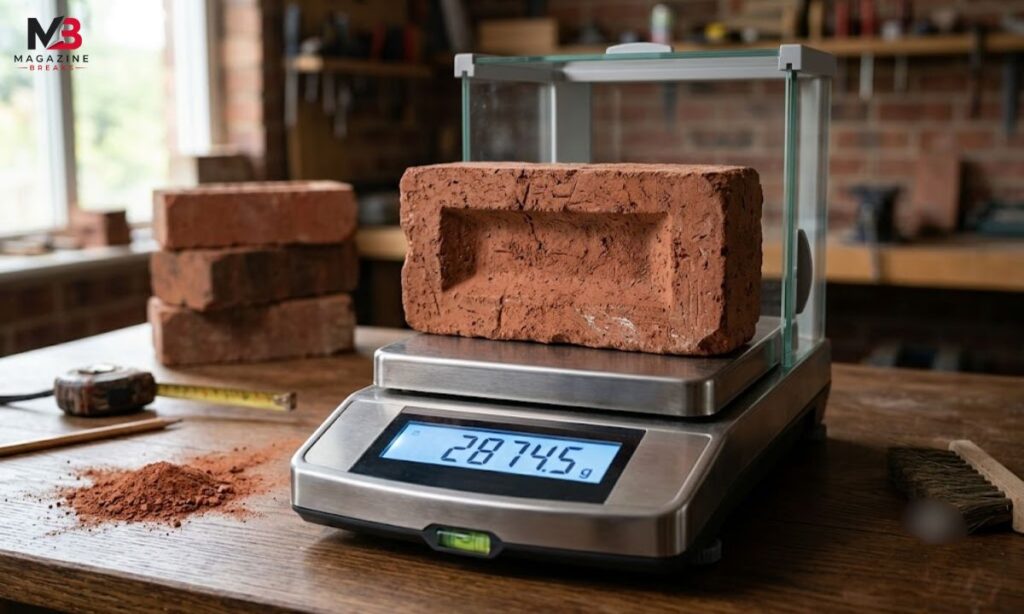
A standard clay brick weighs about 2040 grams. Most weight of red clay bricks falls between 1500 and 4500 grams depending on type and density.
Heavier engineering bricks push closer to 4500 grams. Lighter decorative ones sit near 1500 grams.
For quick math on big orders, remember that 1000 standard clay bricks weigh roughly 3 to 3.5 metric tons. That is a serious load for any truck.
Brick Weight by Size and Dimensions
Brick weight by size is where things get interesting. A small modular brick weight is very different from a massive Double Monarch. Brick dimensions drive almost everything.
Manufacturers like Belden Brick make dozens of sizes. Each one serves a different use, from home facades to commercial towers. Knowing your brick size and weight upfront saves you from nasty surprises on delivery day.
Modular vs. King and Queen

The modular brick weight is about 4.2 lbs (1.9 kg). It is the most common brick used in modern builds. Slightly smaller than old standard bricks but fits perfectly with modern mortar joints.
Queen brick weight comes in at 5.6 lbs (2.54 kg). It is wider and taller, giving walls a bold, chunky look. Great for feature walls and statement exteriors.
King size brick weight is around 6.5 lbs (2.95 kg). Bigger face, fewer bricks needed per wall. Masons love them for faster installation on large projects.
Large-Format Bricks
Once you go big, you really go big. A Utility brick weighs 10.2 lbs (4.63 kg) and is perfect for long wall runs in commercial builds.
The Monarch brick hits 12.5 lbs (5.67 kg). It gives facades a grand, oversized look that smaller bricks simply cannot match.
Then there is the Double Monarch brick at a whopping 25.5 lbs (11.57 kg). You need a strong mason, a solid foundation, and probably a good back to work with these all day.
Clay Brick Weight Comparison
Here is a quick brick weight chart for clay brick weight across popular sizes:
| Brick Type | Dimensions | Weight (lbs) | Weight (kg) |
| Thin Brick | 7-5/8 x 2-1/4 x 3/8 in | 0.88 lbs | 0.40 kg |
| Modular | 3-5/8 x 2-1/4 x 7-5/8 in | 4.2 lbs | 1.90 kg |
| Standard Red | 3-5/8 x 2-1/4 x 8 in | 4.5 lbs | 2.04 kg |
| Roman | 3-5/8 x 1-5/8 x 11-5/8 in | 4.7 lbs | 2.13 kg |
| Queen | 3-1/8 x 2-3/4 x 9-5/8 in | 5.6 lbs | 2.54 kg |
| King Size | 7-5/8 x 3-5/8 x 4-1/2 in | 6.5 lbs | 2.95 kg |
| Utility | 3-5/8 x 3-5/8 x 11-5/8 in | 10.2 lbs | 4.63 kg |
| Double Monarch | 3-5/8 x 7-5/8 x 15-5/8 in | 25.5 lbs | 11.57 kg |
Concrete Brick vs. Concrete Block Weights
Concrete brick weight runs heavier than clay in most cases. The concrete block weight depends on the aggregate mix used. Denser aggregate means a heavier block.
Concrete masonry units (CMU) are the backbone of load-bearing walls and foundations. Unlike clay bricks, they are not fired in a kiln. They are cast and cured, which changes how their weight is distributed.
The Dense Concrete Block
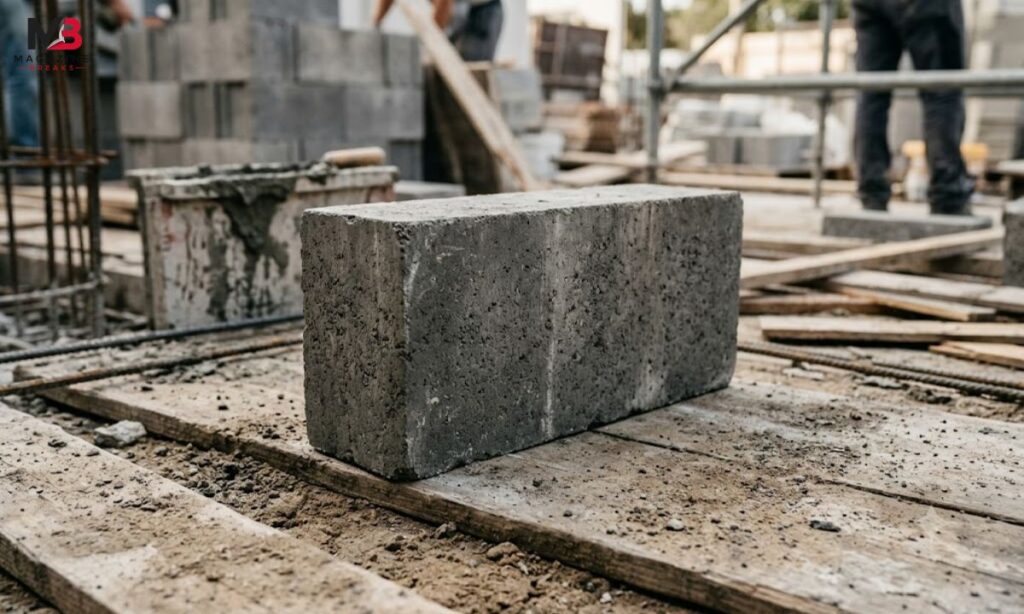
A standard cinder block weight for an 8 x 8 x 16 inch block is about 32 lbs (14.5 kg). These are the go-to choice for retaining wall blocks and structural foundations.
A dense concrete block wall can weigh up to 90 lbs per square foot. That tells you exactly why these walls need serious footings beneath them.
If you are doing brick load calculation for a basement or garage wall, always use CMU weight figures from your supplier spec sheet. Brand and region can shift the number by 2 to 3 lbs.
Lightweight and Aircrete
Not every project needs that much mass. Lightweight concrete blocks use shale or clay aggregate to drop the weight to around 16 lbs (7.26 kg).
Aerated concrete blocks go even further. Air is mixed into the concrete, creating tiny bubbles inside. These blocks weigh as little as 8 lbs (3.63 kg) and have great insulation properties of bricks for energy-efficient builds.
The tradeoff is structural strength. Lightweight concrete blocks work great for interior partition walls but are not ideal for heavy load bearing wall materials.
Hollow vs. Solid Brick Weights
Hollow brick weight is noticeably lighter than solid brick weight. A standard hollow core brick at 8 x 8 x 16 inches weighs about 18 lbs (8.16 kg) compared to 32 lbs for a solid block.
Those holes do two jobs at once. They reduce weight and trap air, which improves the insulation properties of bricks in the finished wall. Smart design, honestly.
Expanded clay bricks take this further, weighing as little as 6 lbs (2.72 kg). These are popular for upper-floor additions where keeping the brick wall load low really matters.
Thin Brick and Veneer Weights
Thin brick weight comes in at just 0.88 lbs (400 grams) per piece. The thin brick veneer is only 3/8 to 1/2 inch thick but looks exactly like a full brick wall.
Brick veneer weight runs about 5 to 6 lbs per square foot. You can install it directly on drywall without any extra structural work. Perfect for kitchen backsplashes and fireplace makeovers.
If you want the brick types and dimensions look without the heavy construction material weight, thin brick is your best friend on renovation projects.
Specialty Bricks: Fire, Pavers, and Roman
Fire brick weight is around 7.7 lbs (3.5 kg) for a standard piece. High-temp versions used in industrial kilns can reach 9 lbs (4.1 kg) because of their denser refractory clay.
Insulating fire bricks are porous by design, dropping to about 5 lbs (2.3 kg). These are the ones you find lining pizza ovens where you want heat retention, not mass. They are true fireproof building materials for high-heat environments.
Paver brick weight averages between 5 to 8 lbs depending on thickness. Roman brick weight sits around 4.7 lbs (2.13 kg) with a long, flat shape that gives walls a sleek, horizontal look popular in modern architecture.
How Much Does a LEGO Brick Weigh?
A standard 2×4 LEGO brick weighs about 2.22 to 2.5 grams. A smaller 1×4 brick weighs around 1.6 to 1.7 grams.
The weight varies because different colors use slightly different plastic blends. Transparent bricks use polycarbonate instead of standard ABS plastic, which shifts the weight.
Fun fact: LEGO scale is roughly 1:40 compared to real life. So if you are building a minifigure-scale brick house, your “construction material weight” calculations are blissfully manageable.
Calculating Weight for Construction Projects
Building material calculations start with knowing your per-brick weight. From there, everything else is multiplication.
Always factor in brick density, mortar weight (which adds roughly 10 to 15% to total wall weight), and any reinforcement inside the wall. Skipping mortar in your estimates is a common and expensive mistake.
The “Bricks per Ton” Rule
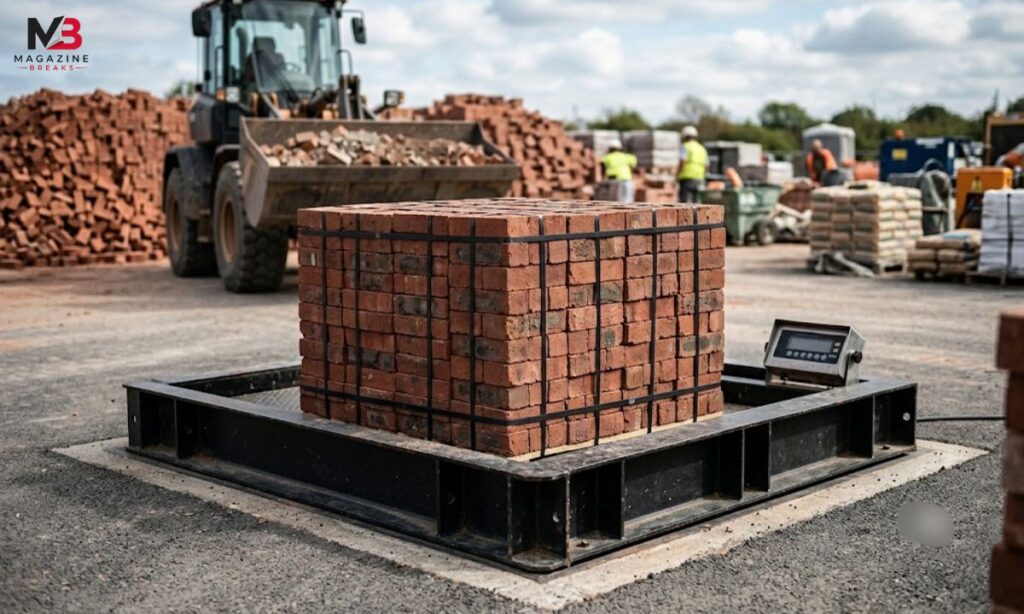
Bricks per ton for standard red bricks equals about 444 bricks. This uses the 4.5 lb average weight as the base.
This rule only works for standard red bricks. If you switch to utility brick weight or king size brick weight, recalculate. Different brick, different number.
Use your supplier’s spec sheet for exact weights when ordering bulk. Even a 0.5 lb difference per brick adds up to hundreds of pounds on a full pallet of bricks weight.
Pallet Weight
A typical brick pallet weight estimate for 500 standard red bricks is about 2,250 lbs (1,020 kg). That is over a ton on a single pallet.
You need at minimum a 3/4-ton truck to haul one pallet safely. A full-ton pickup is better. Overloading a truck with masonry brick weight is dangerous and illegal in most places.
Always check your vehicle’s payload rating before loading up. No brick wall is worth wrecking your truck or causing an accident.
Total House Weight
A typical two-story home with a brick facade across 2,000 square feet carries a house brick facade weight of 200,000 to 300,000 lbs.
That number explains why brick homes need deep, reinforced concrete footings. The foundation load calculations are not optional; they are critical to the building not shifting or cracking over time.
Always consult a licensed structural engineer for any project where brick wall load impacts the foundation design.
Why Brick Weight Matters
Transportation of bricks is the first practical reason weight matters. Load too much, and you damage your vehicle. Load too little, and you make unnecessary trips.
Construction weight planning affects every layer of a project, from the truck to the footing to the floor joist. Getting it wrong at the start creates expensive problems later.
Whether you are a DIYer tiling a kitchen backsplash with thin brick veneer or a contractor laying load bearing wall materials for a commercial build, knowing your brick weight in pounds and brick weight in kg is simply non-negotiable.
Conclusion
Brick weight is not one-size-fits-all. A thin brick weight of 0.88 lbs and a dense concrete block at 32 lbs are both called “bricks” in everyday conversation, but they live in completely different worlds.
Know your brick type, check the brick dimensions, use the brick weight chart above, and always cross-check with your supplier spec sheet before ordering.
Got a project coming up? Drop your brick type and project details in the comments. Happy to help you run the numbers.

Jack is the creator and author behind Measuremently, a platform focused on measurements, dimensions, and size comparisons. Passionate about making measurements easy to understand, Jack shares practical measurement guides, easy-to-follow comparison articles, and educational content to help readers visualize lengths, weights, heights, and distances with confidence.